A plate pack starts spraying slurry from its edges ten minutes into the cycle. Or the pressure gauge climbs normally, then slowly falls during the hold stage. Operators usually reach for the feed pump setting first. In most cases, that is the wrong place to look.
Filter press pressure is not one number. It is three separate pressures, each with its own job, and they only work when set in the right order. This guide explains what each pressure does, how to set it, what typical ranges look like by application, and how to diagnose the most common pressure faults.
The Three Pressures in a Filter Press
Every cycle on a chamber or membrane filter press involves three distinct pressures:
- Hydraulic clamping pressure pushes the plate pack together and keeps the plate sealing surfaces tight.
- Feed pressure pushes slurry into the chambers so liquid passes through the filter cloth and solids build into a cake.
- Membrane squeeze pressure (membrane presses only) inflates the diaphragm behind the cake to squeeze out additional liquid.
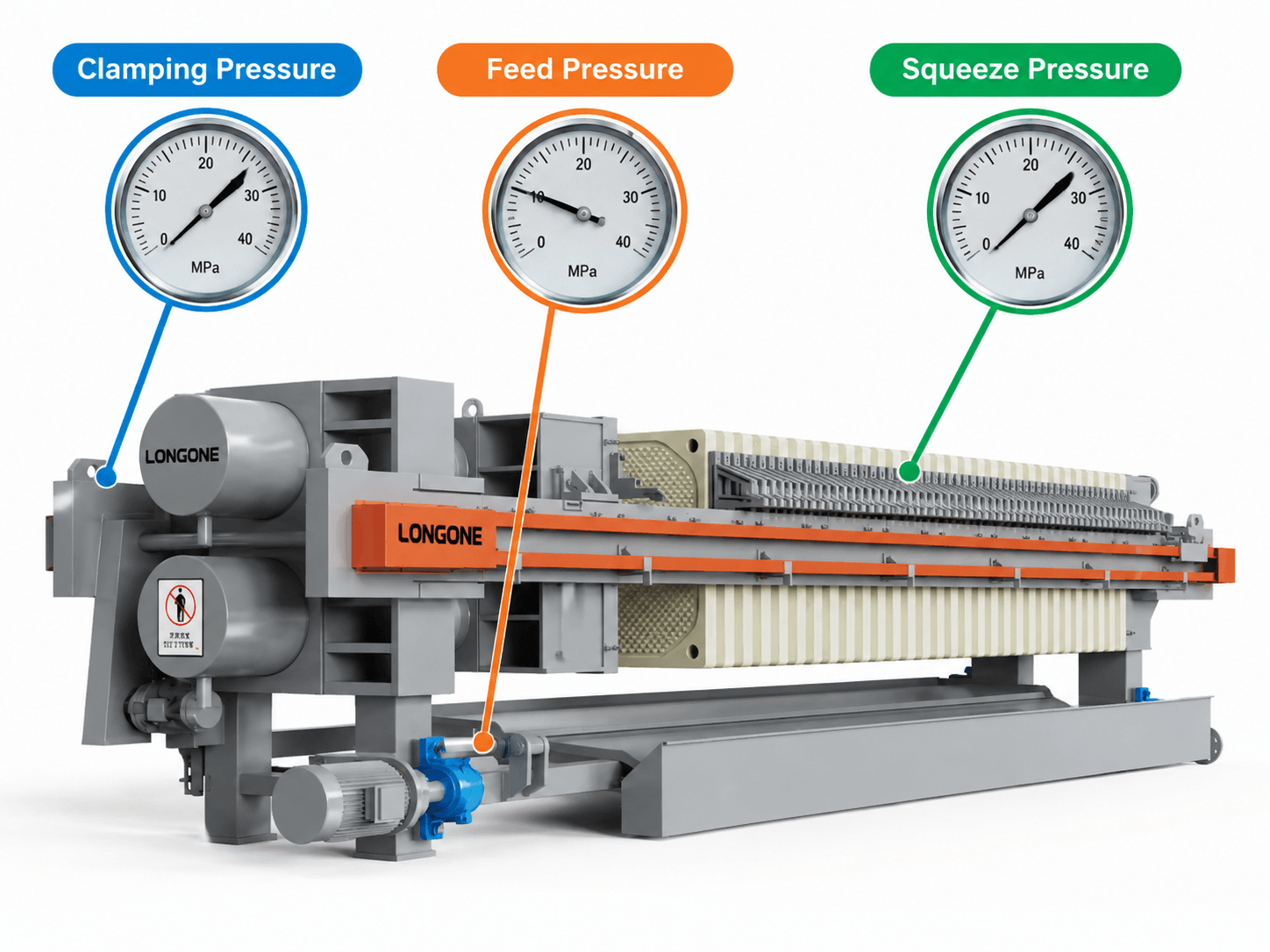
The order matters. Clamping must be established and held first. Feed pressure then works against the clamped plate pack. Squeeze pressure comes last, after the cake has formed. If the first step is weak, everything after it fails.
| Pressure type | Function | Typical range* | Common problem | Adjustment tip |
|---|---|---|---|---|
| Hydraulic clamping | Seals the plate pack against internal pressure | Set to exceed separating force with a safety margin; follow the equipment manual | Leakage, spraying, pressure drop in hold stage | Check hold-pressure and auto-replenishment before touching feed settings |
| Feed pressure | Drives slurry into chambers and forms the cake | About 0.6–1.0 MPa (6–10 bar / 87–145 psi) for most standard plates; up to 1.6 MPa with rated plates | Cloth blinding, uneven cakes, plate damage if over-rated | Fill at low pressure, then ramp gradually |
| Membrane squeeze | Compresses the formed cake for extra dryness | About 1.0–1.6 MPa (10–16 bar / 145–232 psi) in typical duty; higher on high-pressure designs | Diaphragm fatigue, insufficient dryness if started too early | Start squeeze only after feed flow has dropped to a trickle |
*Typical ranges are for general guidance. Plate pressure ratings and the equipment manual always take priority.
Hydraulic Clamping Pressure: How Much Is Enough to Keep Plates Sealed
Clamping pressure is the foundation of the whole cycle. The rule is simple: clamping force must always exceed the separating force created by the feed pressure inside the chambers, with a safety margin.
Separating force is roughly the internal pressure multiplied by the projected chamber area. As an illustration only, a 1000 mm plate pack with about 0.8 m² of projected area at 0.8 MPa feed pressure produces a separating force of around 640 kN, or roughly 65 tonnes of force pushing the plates apart. The hydraulic system must resist that continuously, not just at the moment of closing.
This is why the gauge reading on the pump station is only half the story. What matters is whether the system can hold pressure through the full cycle. Two features deserve attention:
- Hold pressure: Once the cylinder reaches its set point, the system should maintain it. Internal valve leakage or a worn cylinder seal can let pressure creep down.
- Automatic replenishment: As the cake builds and plates shift slightly, the hydraulic pump should top up the pressure automatically. If it does not, clamping force drops just when it is needed most.
Signs of under-clamping include slurry seeping at plate corners, wet streaks along the plate edges, and pressure that falls steadily during the hold stage. Raising feed pressure in this situation only makes leakage worse.
Feed Pressure: Why a Gradual Ramp Beats a Hard Push
Feed pressure is the most adjusted and most misunderstood setting. Many operators assume more feed pressure always means drier cake. In practice, the relationship is not linear.
Once a cake layer forms on the cloth, it becomes the main filtration resistance. Pushing harder compresses the outer cake surface, which can close pores and slow drainage. On fine or compressible materials, high feed pressure can blind the cloth and shorten its service life without improving dryness.
A better approach is a staged feed:
- Low-pressure fill. Let slurry fill the chambers gently so the cloth is evenly coated and a stable initial cake forms.
- Gradual ramp. Increase pressure step by step as the cake builds and filtrate flow slows.
- Hold at target. Maintain the set pressure until filtrate flow drops to a trickle.
This method gives more uniform cakes, reduces mechanical stress on plates, and extends cloth life. It also makes the pressure curve a useful diagnostic: a healthy cycle shows a smooth rise, while spikes or plateaus point to blocked feed ports, damaged cloth, or inconsistent slurry.
Membrane Squeeze Pressure: Drier Cake Without Overloading Plates
On a membrane filter press, the squeeze stage is where much of the final dryness is gained. After feed filtration, compressed air or water inflates the diaphragm on each plate. The diaphragm presses on the cake from one side, forcing out liquid that feed pressure alone cannot remove.
Squeeze is most valuable for compressible materials such as municipal sludge, fine mineral tailings, and some chemical slurries. For these, extra feed pressure delivers poor returns, while a squeeze stage can reduce moisture significantly.
Practical points for setting squeeze pressure:
- Timing: Begin squeezing only after the feed stage has formed a complete cake and filtrate flow has slowed. Starting too early can distort the cake and trap liquid.
- Pressure level: Typical duty runs in the 1.0–1.6 MPa range. Higher pressures are possible only on plates and diaphragms rated for them. LONGONE high-pressure membrane presses, for example, are designed for squeeze pressure up to 4.0 MPa for demanding dewatering duties.
- Diaphragm life: Repeated cycles at the upper end of the rated range accelerate diaphragm fatigue. Match squeeze pressure to the dryness target rather than always running at maximum.
Typical Pressure Settings for Sand Washing, Coal Slurry, and Sludge
Different materials respond differently to pressure. The table below gives general starting ranges. Always confirm against your plate rating, slurry data, and equipment manual before running a new material.
| Applicazione | Material behavior | Typical feed pressure | Squeeze (membrane press) | Key consideration |
|---|---|---|---|---|
| Sand washing | Coarse, free-draining, low compressibility | About 0.6–0.8 MPa | Often not required | Fast cake formation; protect cloth from abrasion |
| Coal slurry | Fine particles, moderate compressibility | About 0.8–1.0 MPa | About 1.0–1.6 MPa when used | Cloth blinding risk with ultrafine fractions |
| Municipal / industrial sludge | Highly compressible, high moisture | About 0.6–1.0 MPa | About 1.2–1.6 MPa or higher | Squeeze delivers most of the dryness gain |
Temperature also changes what is safe. Polypropylene plates lose pressure capacity as operating temperature rises. A setting that is comfortable in winter may be too aggressive for hot slurry or summer ambient conditions. For hot processes, confirm the plate’s derated pressure at operating temperature, not only the nameplate rating.
Troubleshooting Pressure Problems: Spraying, Leakage, and Pressure Drop
Most pressure complaints trace back to a small set of causes. Work through them in order, starting with the clamping side.
Slurry spraying from plate edges
- Check clamping pressure and the hold/replenishment function.
- Inspect plate sealing surfaces for wear, cracks, or trapped solids.
- Look for folded, wrinkled, or misaligned filter cloth at the edges.
- Confirm that the feed pressure does not exceed what the clamping system can resist.
Pressure drops during the hold stage
- Check the hydraulic system for internal leakage through valves or cylinder seals.
- Verify that the pressure switch or sensor is calibrated correctly.
- On membrane presses, check the squeeze circuit for air or water leaks and diaphragm damage.
Pressure does not build at the feed pump
- Check for open or damaged plate ports and cloth holes that let slurry bypass the cake.
- Inspect the feed line, valves, and pump wear.
- Confirm slurry concentration, since very thin slurry builds pressure slowly.
Pressure climbs too fast
- Look for blocked feed ports or heavily blinded cloth.
- Check whether slurry solids or particle size have changed.
- Review the ramp settings so the fill stage is not skipped.
A useful habit is recording the pressure curve for each cycle. Over time, the curve becomes a baseline. Deviations from it show developing faults before they cause leakage or plate damage.
Safety note: Never operate any filter press above the rated pressure of its plates, diaphragms, and hydraulic system. Do not bypass pressure relief devices, and always depressurize the system before opening the plate pack or working on filter cloth.
Conclusion
Every slurry behaves differently, and the best pressure settings come from real data. If you can share your material type, solids content, particle size, and dryness target, our engineers can suggest a starting pressure profile and a suitable press configuration. You are welcome to get in touch with those details whenever it suits your project.
Frequently Asked Questions
What is a normal filter press operating pressure?
Most standard chamber filter presses run feed pressure of about 0.6–1.0 MPa (6–10 bar). Plates rated for higher pressure can operate up to 1.6 MPa. The right figure depends on the plate rating, the material, and the dryness target.
How much clamping pressure does a filter press need?
Enough that clamping force exceeds the separating force created by feed pressure, with a safety margin. The exact hydraulic setting depends on cylinder size, plate area, and feed pressure, so follow the manufacturer’s manual rather than a generic number.
Does higher feed pressure give drier cake?
Not always. After the cake forms, extra feed pressure often compresses the cake surface and can blind the cloth without improving dryness. For compressible materials, a membrane squeeze stage usually works better than raising feed pressure.
Why does my filter press lose pressure during pressing?
The most common causes are hydraulic leakage, a worn cylinder seal, a faulty pressure switch, or leaks in the squeeze circuit on membrane presses. Check the clamping system first, then the plates and cloth.
How do I choose pressure for a new material?
Start at the lower end of the typical range, use a low-pressure fill and gradual ramp, then adjust based on cake dryness and filtrate flow. Testing a small sample on a lab-scale press gives more reliable settings than estimating.